Government aiming to build 300,000 houses by 2030

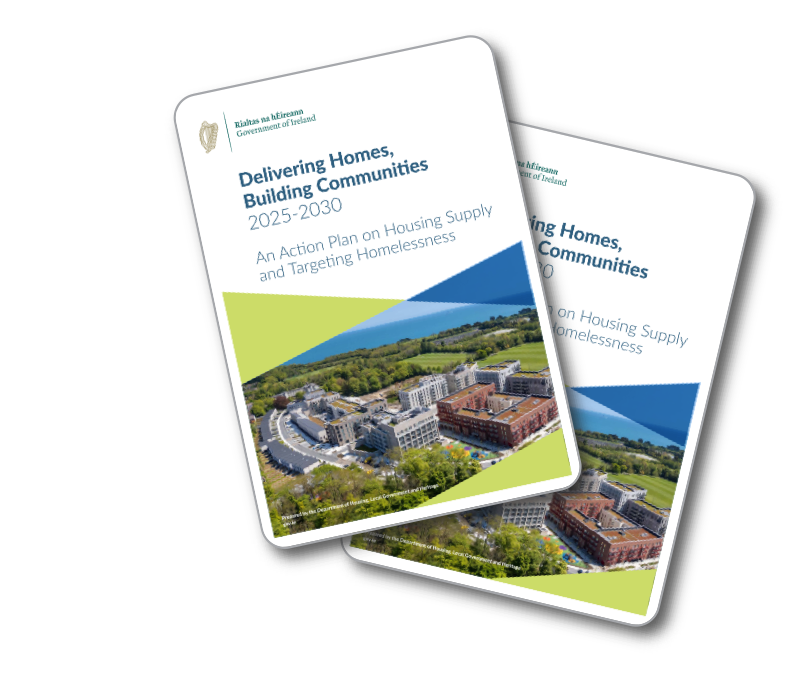
In November 2025, Minister for Housing, Local Government and Heritage James Browne TD announced the Government’s new housing plan, Delivering Homes, Supporting Communities 2025-2030, after multiple delays through the year. The plan outlines the Government’s ambition to build 300,000 new houses by the year 2030.
Delivering Homes, Supporting Communities was originally supposed to be announced in July 2025, some six months after the Government was formed. However, it was not until November 2025 that the Government set a target of building 300,000 homes by 2030, which would require 60,000 homes to be built per year. Achieving this would require the number of dwelling completions to almost double from the 2024 figure, in which the CSO reports that 30,330 homes were built.
In June 2025, The Irish Times reported that senior government sources were claiming that the delay was due to the fact that multiannual funding could not be secured until the publication of the review of the National Development Plan (NDP). However, the plan was announced prior to the NDP review, which was itself delayed by several months.
With increasing supply, rather than government interventionism in the market itself, underpinning the Government’s housing ambitions, the new plan set out two pillars, with one focused on ‘activating supply’ while the second centres on ‘supporting people’.
Pillar one: Activating supply
Zoned and serviced land
Pillar one outlines a system of measures intended to activate the supply of 300,000 homes by ensuring a consistent pipeline of zoned and serviced land. The plan sets out an objective to increase the availability of suitably zoned land across the country while providing greater procedural certainty in the planning system.
Key actions include zoning additional land to meet projected housing requirements and implementing the Planning and Development Act 2024 to streamline planning timelines and simplify processes. The plan also identifies the need to accelerate the development of new urban communities, building on the established models in locations such as Clonburris and Adamstown, where integrated planning and infrastructure sequencing have proven effective in facilitating large-scale housing development.
Delivering infrastructure
Infrastructure provision is treated as a prerequisite for housing activation. The plan aims to increase investment in water, wastewater, electricity, and road infrastructure to ensure that land can be brought to ‘development ready’ status. Funding allocations include €12.2 billion for the water sector and €3.5 billion in equity funding for electricity grid infrastructure for the period 2026-2030.
The introduction of a €1 billion Infrastructure Investment Fund is intended to reduce delays associated with upfront infrastructure delivery on strategic sites. The full embedding of the Housing Activation Office is intended to support improved coordination between infrastructure providers, local authorities, and developers, ensuring that infrastructure is delivered in a manner aligned with housing need.
Attracting investment
The plan identifies the need to create conditions that support inward investment from domestic and international sources to fund new housing development. It outlines significant exchequer commitments, including almost €20 billion for social and affordable housing delivery, alongside further capitalisation of the Land Development Agency (LDA) through an additional €2.5 billion to support its expanded delivery role.
A focus is placed on addressing viability challenges, particularly for apartment and higher-density developments. Measures include reducing VAT on apartments from 13.5 per cent to 9 per cent, introducing a corporation tax exemption for cost rental homes, and applying enhanced corporation tax deductions. These mechanisms are presented as tools to influence construction costs downward and improve the feasibility of new housing across tenures.
Skills and MMC
Meeting projected housing output requires increases in construction capacity, skills, and productivity. The plan aims to expand the sector’s skill base through a renewed action plan to promote careers in construction and a new five-year action plan for apprenticeships.
Parallel to skills development, greater adoption of modern methods of construction (MMC) is identified as essential in achieving efficiency, quality, and cost improvements. Actions include optimising NSAI’s Agrément certification processes to support innovative products, doubling investment in the Built to Innovate programme, and applying MMC to at least 25 per cent of new social and affordable homes. These measures are designed to create a more efficient construction ecosystem capable of meeting scaled delivery targets.
Dereliction and vacancy
Returning derelict and vacant buildings to use is presented as a key element of supply activation and urban regeneration. The plan sets an objective of increasing the volume of homes brought back into use through measures such as a new derelict property tax administered by the Revenue Commissioners, the target of returning 20,000 vacant homes to use supported by the Vacant Property Refurbishment Grant, and an expanded Living City Initiative covering all residential properties built before 1975. These initiatives aim to address dereliction, improve place quality, and increase residential capacity in towns and cities.
Pillar two: Supporting people
Homelessness
Pillar two outlines actions intended to improve outcomes for people experiencing homelessness and to support populations with specific housing needs. Homelessness is identified as the most pressing social challenge, and the plan aims to improve service coordination through an integrated, cross-government approach.
Actions include allocating €100 million in capital funding for the acquisition of second-hand properties to support families who have spent prolonged periods in emergency accommodation, developing a Child and Family Action Plan, and delivering more than 2,000 Housing First tenancies for individuals with complex needs. Local authorities are expected to make sufficient social housing allocations to reduce long-term family homelessness.
In addition to homelessness, the plan addresses the needs of older people, disabled people, and the Traveller community. Key measures include increasing the supply of suitable accommodation options for older people, progressing the National Housing Strategy for Disabled People 2022-2027 alongside the National Human Rights Strategy for Disabled People 2025-2030, expanding the Housing Adaptation Grant for Older People and Disabled People, and continuing investment in Traveller-specific accommodation.
Social housing output
The plan sets out an objective to deliver an average of 12,000 new social homes per year. To support this, it aims to streamline administrative processes through a single-stage approval mechanism for qualifying projects and to expand and simplify the operation of the Land Acquisition Fund. Financial incentives for local authorities are intended to encourage them to exceed their “own build” targets.
Revised housing delivery action plans are expected to ensure that the mix of social homes delivered by local authorities, approved housing bodies (AHBs), and the LDA align with locally identified needs and demographic profiles.
Promoting affordable homeownership
Affordability supports are outlined to address challenges associated with the undersupply of homes, population growth, and price inflation. The plan aims to deliver an average of 15,000 affordable housing supports annually through the Starter Homes Programme. The LDA’s remit will be expanded to scale up its delivery of affordable homes, and continued support for the Help to Buy Scheme and First Home Scheme is intended to assist buyers with deposit and financing gaps.
In relation to the rental sector, the plan sets out actions aimed at increasing supply, stabilising rents, and strengthening tenant protections. Measures include national rent controls, reforms to the Rent Pressure Zone system to support investment in the rental market, and new legislation to enhance tenant security.
Oversight by the Residential Tenancies Board will be strengthened, a national rent price register will be established to improve market transparency, and the regulation of short-term letting will be expanded to protect long-term rental availability.
Investing in local communities
The plan aims to enhance quality of life in existing communities through targeted investment in the built environment. Actions include supporting small and medium-sized builders to deliver mixed-tenure developments on serviced sites in towns and villages, implementing remediation schemes for defective concrete blocks and defective apartments, and publishing a National Planning Statement on rural housing. The Town Centre First model will continue to receive funding to support the revitalisation of rural towns and promote increased residential occupancy in town centres.
Did Housing for All deliver?
In 2021, there was significant fanfare when then-Minister for Housing, Local Government and Heritage Darragh O’Brien TD set out a government housing plan with unprecedented levels of targets and state interventionism.
Housing for All set out an annual construction target of 33,000 per year and aimed to reduce homelessness. It failed spectacularly with homelessness at a record high and housing supply decreasing in 2024. The data shows that completion rates somewhat improved, albeit significantly below demand, and homelessness continuing to rise sharply.
On completions, Central Statistics Office (CSO) figures indicate 32,695 new dwelling completions in 2023, up 10 per cent from 2022. In 2024, completions dropped to 30,330, a 6.7 per cent fall compared with the previous year, and significantly below the 33,450-home target set for 2024. Even though 2022 and 2023 saw figures close to or slightly above earlier interim targets, the overall annual output remained below the levels that many observers regard as necessary to ease supply pressures.
Despite this building activity, homelessness, measured by numbers in emergency accommodation, has worsened to record levels. In September 2024, there were 14,760 individuals in such accommodation. By March 2025, that figure had climbed to 15,378 people, including thousands of children. By mid-2025, the total reached 15,747. The latest increase in homelessness means that homelessness has increased in every month since the Fianna Fáil-Fine Gael-RIG government took office one year ago.
In addition, although the then-minister continually boasted through 2024, prior to the election, that the Government would not only meet its 33,000 target but exceed 40,000, the real figures, released by the CSO shortly after the general election, showed that only 30,330 homes were built, a contraction of 6.7 per cent on the previous year.
The 2024 general election campaign, the end of which saw Fianna Fáil and Fine Gael returned to office, saw housing remain a significant topic of debate. However, the introduction of immigration into national discourse, alongside the repeated citation of dubious dwelling completion delivery projections by senior government ministers, meant that the verbosity with which housing was debated in the 2020 campaign was not repeated in 2024.
On 25 August 2024, then-Taoiseach Simon Harris TD said: “This year [2024], we will exceed our housing targets with almost 40,000 homes built.”
“I am going to end the housing crisis in my term.”
Minister James Browne TD
On 24 October 2024, then-Housing Minister Darragh O’Brien TD responded to a question addressed to him in the Dáil by Sinn Féin’s Eoin Ó Broin TD saying: “I still confidently predict – the Deputy and his colleagues in Sinn Féin will be disappointed – that it will be in the high 30,000s to low 40,000s this year.” The official Housing for All target at that point was 33,450 homes.
On 11 November 2024, O’Brien posted on X (Twitter): “Housing delivery has risen from 20,000 in 2020 approaching 40,000 homes this year.” On the following day, then-Finance Minister Jack Chambers TD stated in a television debate: “This year we will have over 35,000 homes being built.”
However, on 6 November 2024, an internal Department of Finance briefing, Monthly Housing Update November 2024, circulated to Minister Chambers, indicated that housing completions for the year were expected to be similar to or slightly lower than the 32,695 completions achieved in 2023. The document, later released under the Freedom of Information Act, said that completions were broadly aligned with the Central Bank’s revised forecasts.
The general election was held on 29 November 2024, with the two main parties in the then-triparty coalition returned to office just two seats short of an overall majority in the Dáil.
When the CSO released its final dwelling completions data for 2024 in January 2025, it confirmed that only 30,330 homes had been completed in the year, significantly below the figures cited during the election campaign.
Following the publication of the final figures, Sinn Féin leader Mary Lou McDonald TD, speaking in Leaders’ Questions in the Dáil on 5 February 2025, described the Government’s projection of 40,000 homes as an attempt to mislead the public.
Taoiseach Micheál Martin TD responded that the statements made during the campaign were based on “a genuine belief that we were heading for the high thirty-thousands”. He said: “There was no attempt to mislead anybody in that regard. We got the figure wrong in terms of what we thought might happen. The target was 33,000 [sic]. We thought it would be much higher than that. I regret that.”
Tánaiste Simon Harris TD was asked on RTÉ’s Claire Byrne Live on 7 February 2025 whether the 40,000-figure had “misled the public”. He said: “You can only mislead people if you provide information to the public that you know to be untrue.” He acknowledged, however, that the figure should not have been provided to the coalition leaders in August 2024: “I think that is true that they should not have given the figure.”
Harris added that the projection had been provided in good faith, based on projections and analysis from Deutsche Bank, EY, and Cairn Homes.
Commentary
The Government has been bold in asserting that this plan will resolve the housing crisis, which is now entering its 13th year. Ahead of release of the plan, Minister Browne said: “I am going to end the housing crisis in my term and I believe that can be done.”
Speaking after Delivering Homes, Supporting Communities was published, the Minister said: “Already this year [2025], the Government has delivered a Revised National Planning Framework, enabling the zoning of significantly more land. We have introduced unprecedented reform of Rent Pressure Zones and the revision of Apartment Standards Guidelines. This is along with a reduced VAT rate on apartments, all aimed squarely at making badly-needed delivery of apartment building more viable so supply is ramped up.
“Any move which will provide more homes is on the table and this plan captures the necessary and appropriate actions needed. In particular, under this plan, we will deliver 72,000 social homes to ensure those with a real need have access to a high quality, safe and secure home of their own.”
On homelessness, Browne said: “Homelessness numbers remain far too high and I will rapidly implement a new dedicated Child and Family Homelessness Action Plan to tackle all aspects of child and family homelessness. This will include increased funding as well as €100 million in 2026 for a ground-breaking acquisition programme for long-term homeless families.
“I am determined to place an increased emphasis on homelessness prevention, and we will implement a National Homelessness Prevention Framework which will set out measures and actions to address the causes for how and why people become homeless.”
The opposition has been less optimistic, with Sinn Féin housing spokesperson Eoin Ó Broin TD describing the new plan as one written by and for “big investors, big developers to benefit their private interests”. He described it as “the emperor with no clothes” and accused the Government of “brazenly trying to rebrand unaffordable private homes as somehow affordable”.
The Labour Party, Social Democrats, and People Before Profit added their objections, as did the Government’s former coalition partners, the Green Party, which branded the plan ‘delivering homelessness, blaming communities’.